b2e@zeic.ca


Retrofitting existing multi-unit residential buildings (MURBs) with electric heat pumps is widely recognized as a critical pathway to enhancing occupant comfort, improving energy efficiency and reducing carbon pollution. With heat waves becoming more frequent, heat pumps improve comfort in homes thanks to the cooling they provide. Heat pumps use less energy than electric baseboard heaters, reducing electricity bills and the load on the electrical grid. As the emissions factor for gas is 16x higher than electricity, switching from gas heating to electric heat pumps greatly reduces a household’s carbon footprint.
Yet, despite mature technology and strong policy support, many heat pump projects stall due to perceived technical, regulatory, and organizational barriers. This case study documents a successful heat pump retrofit of a 51-unit B.C. townhouse complex that overcame these barriers through pragmatic design, contractor-led problem solving, and a streamlined municipal permitting process.
An experienced mechanical contractor (and B2E member), Combined Comfort Systems (CCS), replaced electric baseboard heating with multi-zone ductless heat pumps in individual units and a ducted system for the common areas. The result was a streamlined installation thanks to minimal permitting requirements and costs, ample electrical service capacity and unanimous resident approval based on expected reductions in space-heating electricity use of approximately 70–75%. The project demonstrates how municipalities can enable electrification retrofits by focusing on outcomes—safety and reduced electrical demand—rather than defaulting to complex and costly procedural requirements.
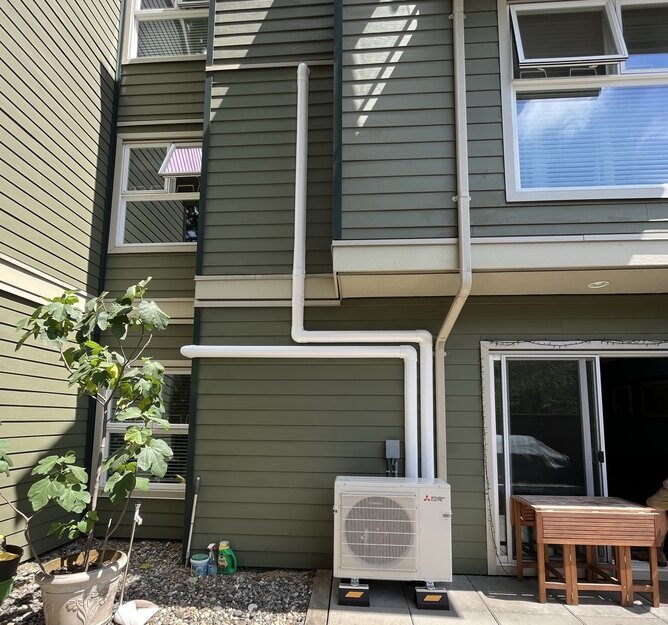
Outdoor unit connected to three indoor heads
About the Project
The all-electric co-operative housing townhouse complex, located in Burnaby, B.C., was constructed in the 1970s and consists of 51 units, including one-, two-, and three-bedroom residences. Each unit is individually metered and was originally heated entirely by electric baseboard heaters. Domestic hot water is generated by electric hot water tanks. Common areas of the complex include a meeting room, laundry room and administrative office. The complex is served by a 1,200 A, 208 V, three-phase electrical service and each unit has a 100 A panel board.
Naturally, affordability, predictability of costs, and retrofit disruption were central concerns for the residents. For the two years preceding the project, the residents had explored heat pumps with other mechanical contractors but encountered uncertainty about feasibility, electrical capacity, permitting complexity, and cost. As a result, the prevailing perception was that a full conversion would be onerous, slow, and potentially risky.
Contractor-Led Problem Solving
The retrofit was never deemed impossible, but progress stalled for several years due to a several hurdles.
The identified barriers were not uncommon for existing buildings:
- Concerns over electrical capacity, driven by an assumption that heat pumps would only add electrical load (for cooling) rather than replace a high electrical load (for heating)
- Fire separation and envelope penetration concerns, particularly in multi-unit buildings,
- Expectations of extensive engineering studies, electrical planning reports, and consultant involvement,
- Uncertainty over permitting pathways, especially for co-operative housing that does not fall neatly into strata regulations
Overall, the challenge was not technology, but assumptions about requirements and processes.
The turning point came when CCS identified an alternative project approach.. As a vertically integrated contractor, they managed the design, permitting, and installation and as a result, greatly reduced the risk and friction for the co-op.
CCS reframed the process by proactively presenting a technically grounded solution to the municipality rather than reacting to a list of conditions. Key elements of this approach included:
- Designing around fire separation concerns by surface-mounting refrigerant lines within suites and avoiding penetrations through fire-rated assemblies
- Minimizing the number of building envelope penetrations and using established weather-sealing practices
- Framing the project as a net electrical load reduction, supported by basic electrical load calculations that compared existing baseboard heating load to the projected heat pump load (at –8 °C).
Crucially, the contractor took responsibility for navigating municipal requirements rather than passing that burden to the co-op. This single point of accountability reduced friction and built confidence among both residents and regulators.
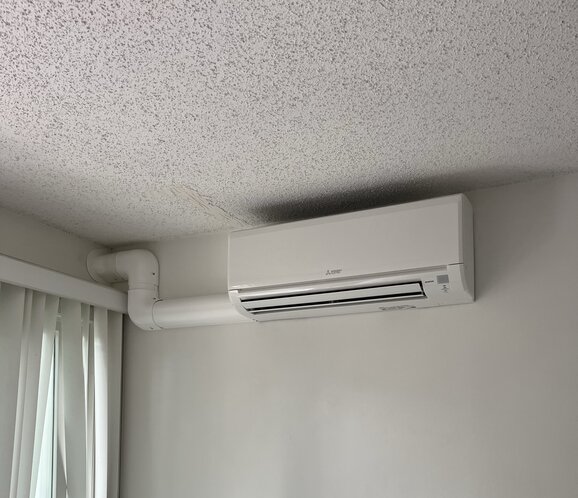
Indoor head inside bedroom
A Streamlined Municipal Permitting Process
Engagement with the City of Burnaby proved decisive. Instead of defaulting to a full mechanical or building permit application process, city staff worked with the contractor to identify what was actually necessary to ensure safety and code compliance. The streamlined permitting pathway included an electrical permit reflecting the changes to branch circuits and equipment, as well as an annual operating permit.
By replacing resistance heating with high-efficiency electric heat pumps, the project reduced peak electrical demand — avoiding the need for an electrical planning report or utility-led capacity study. CCS used a simple worksheet to compare wattage removed versus added and to show that the corresponding heating capacity was sufficient. No engineering or architectural involvement was required and no heat loss calculations were necessary.
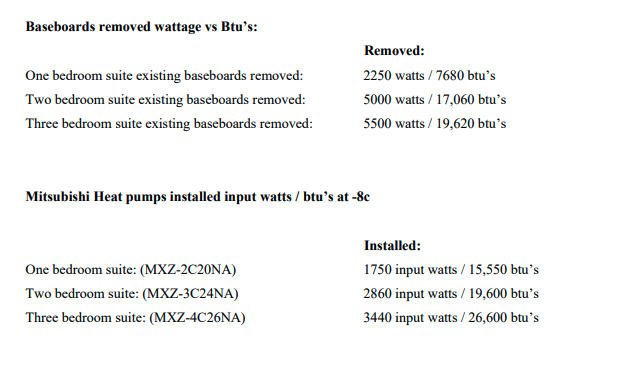
Comparison of power and heating capacity between electric baseboard heaters and Mitsubishi heat pumps
The total permitting cost for the entire complex was approximately $265, an amount that stands in stark contrast to the thousands (sometimes tens of thousands) of dollars often associated with MURB retrofit approvals.
This streamlining of the permitting process serves as a model for other municipalities. Without it, municipal permitting requirements risk becoming a major barrier to heat pump adoption.
A Simple Technical Solution
The retrofit strategy was tailored to the building’s layout and resident needs. Individual units were equipped with multi-zone ductless heat pump systems. Each unit has an indoor head for every bedroom and one for the living area. Building common areas are served by a single ducted heat pump system. Outdoor units are installed on patios and balconies and mounted on purpose-built stands designed to address safety and climb ability concerns.
Nearly all existing electric baseboard heaters were decommissioned. The only units retained are 500 W heaters located at the ground level of select suite stairwells. Wiring to the decommissioned baseboards is now disconnected at the panel boards, thermostats removed, and wiring clearly labeled to prevent reconnection.
The heat pump capacity for each suite is based on the heating capacity of all the removed electric baseboard heaters. Three models were installed for this project – a 20,000 Btu/hr (cooling capacity, ducted) heat pump, a 24,000 Btu/hr heat pump and a 36,000 Btu/hr heat pump. The rated coefficient of performance (non-ducted) ranges between 2.01 and 2.9 at maximum heating capacity and –8 °C. The sound pressure level (in heating mode) ranges between 50 and 54 dB(A) - quieter than most electric toothbrushes!
The Mitsubishi heat pump with the closest total heating capacity (at winter design temperature) to the baseboard heaters removed provides approximately 15% to 100% more heating capacity than the baseboard heaters while using 23% to 43% less power (depending on whether it’s a one, two or three-bedroom suite),
Commissioning followed manufacturer protocols with system performance verified and refrigerant charge confirmed based on lineset length, and the capacity and number of indoor heads.
Multiple Benefits Drove a Unanimous Approval
Resident buy-in was achieved through direct, transparent engagement. A live information session, attended both in person and online, gave residents the opportunity to ask questions about aesthetics, comfort, and operation.
Initial concerns focused on the visibility of surface-mounted linesets and indoor units. These concerns quickly gave way to enthusiasm once residents realized that the retrofit would also provide air conditioning, a growing priority in a warming climate, free up electrical capacity for EV charging, and reduce their utility bills.
Following the session, residents voted on the project. The result was unanimous approval which is a rare outcome for any major building upgrade.
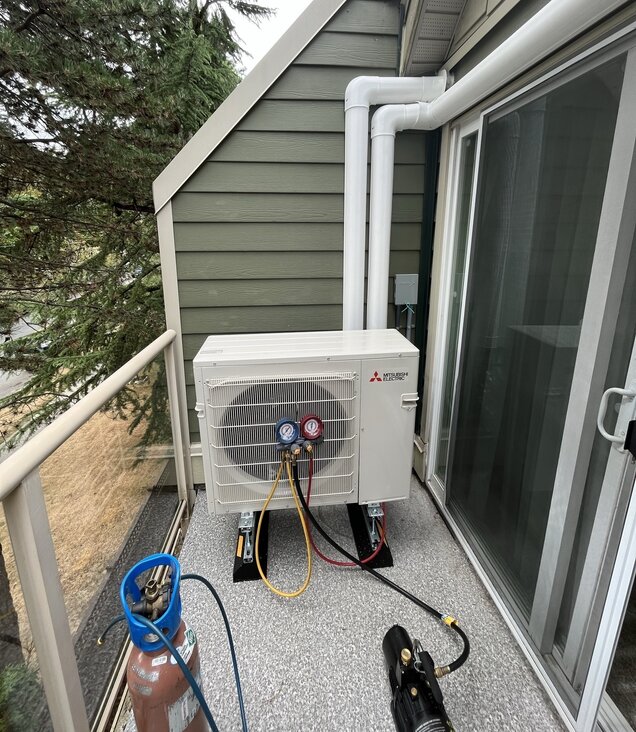
Heat pump on balcony connected to two indoor heads
Performance Expectations
Based on extensive prior experience with similar retrofits, CCS expects space-heating electricity consumption to drop by approximately 70–75% annually. Previous projects using similar Mitsubishi heat pumps have consistently exceeded published efficiency assumptions, particularly in B.C.’s mild coastal climate.
Ultimately, the performance of these heat pumps will depend on proper maintenance. Clogged filters can increase refrigerant pressures when the system is in heating mode, and this can lead to premature equipment issues, including refrigerant leakage. To mitigate this risk, discussions are underway to establish a centralized maintenance program, ensuring filters are cleaned at least twice per year. The BC Non-Profit Housing Association recently published useful guidance on operating and maintaining heat pumps.
A Replicable and Pragmatic Approach
What’s becoming increasingly clear is that one of the biggest barriers to heat pump installation in existing MURBs is not technical—it’s procedural.
By aligning contractor expertise, municipal pragmatism, and resident priorities, a project once seen as complex and risky became straightforward, affordable, and widely supported.
For municipalities, utilities, housing providers, and policymakers, the lesson is clear: enabling outcomes-based permitting for heat pump retrofits can unlock significant emissions reductions, energy savings, and resilience benefits—quickly and at scale.
Further Resource
Want to find out more about heat pumps? BC Non-Profit Housing Association has developed practical guides to help building operators, technicians, and housing providers understand, operate, and maintain heat pump systems with confidence. Click here to find out more.
A B2E publication written in collaboration with Combined Comfort Systems with support from the City of Vancouver.