

Heat Pumps for Residential and Commercial Buildings

What is a heat pump? 

Heat pumps offer reliable heating and cooling in a single system, eliminating the need for a separate air-conditioning (AC) or cooling system. They deliver year-round comfort even at very low outdoor temperatures.

As heat pumps use so little energy, they're an economical way to both heat and cool a building. Rather than generating heat, they use electricity and a refrigeration cycle to move thermal energy from one place to another, pulling heat into the building in winter and out of it in summer. This "moving heat" approach, rather than generating it, is what makes electric heat pumps far more efficient than gas-fired furnaces, boilers, or even electric baseboard heaters.
 

Types of Heat Pump Sources

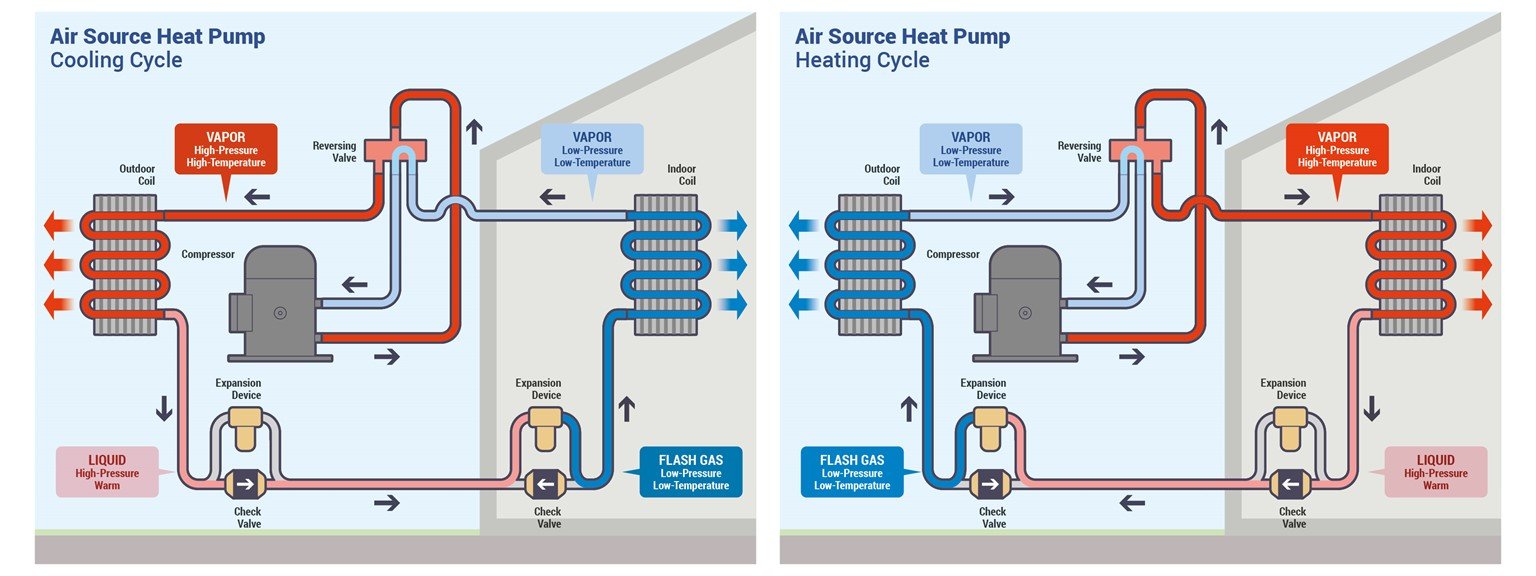
One Switch, Two Seasons

A reversing valve switches the direction refrigerant flows through the system. In summer, that flow reverses: the indoor coil absorbs heat from inside the building, while the outdoor coil releases it outdoors. This turns your heat pump into an air conditioner.

A versatile solution for heating and cooling

Heat pumps are much more efficient than the equipment they replace, with cold-climate models capable of providing efficient heating in temperatures as low as -25°C. They can provide high-efficiency and economical heating and cooling in buildings of all sizes. They are an obvious choice for new buildings and can also be installed in the vast majority of existing buildings. There are a growing number of heat pumps that can also meet the high-temperature requirements of many industrial applications.

Benefits of Heat Pumps

Cooling

With summer temperatures rising, cooling is becoming a necessity in BC homes. For new buildings, the BC Building Code now requires that one room in a home does not exceed 26 C. The most economical and reliable way to ensure this, is by installing an electric heat pump which provides both heating and cooling in a single appliance.

Better air quality

Powered by BC’s clean electricity, heat pumps do not produce toxic carbon monoxide or climate-damaging carbon dioxide emissions, contributing to better air quality and making them a safer option for homeowners and for the planet.

Energy efficiency

Heat pumps are the most energy efficient way to provide heat. Conventional fossil fuel heating systems convert the chemical energy in fuel to heat energy, and therefore cannot be more than 100% efficient. Because one unit of electrical energy can move many units of heat energy, heat pumps can be many times more efficient.

Operating costs

Thanks to their high-efficiency, heat pumps often cost less to operate than pairing a fossil fuel heating systems with air conditioning. Annual household energy bills with a cold climate air source heat pump would be $169 lower than with a natural gas furnace and A/C, and $849 lower than with electric resistance heating and A/C (More for Less).

Frequently Asked Questions

What about the GHG emissions from refrigerants used in heat pumps?

1What about the GHG emissions from refrigerants used in heat pumps?

A refrigerant is a liquid or gaseous compound used to absorb and transfer heat. It is a technology that is used in refrigerators, air conditioners, heat pumps and more. Without refrigerants, air conditioning, refrigeration or freezing technology wouldn’t be possible.   

In 1987, the Montreal Protocol banned refrigerants with a high Ozone Depletion Potential (ODP) but did not address the Global Warming Potential (GWP) of the gases that would replace them. Later in 2016, the Kigali Amendment to the Protocol set an agenda to phase out high GWP refrigerant gases, but many of these refrigerants are still being used.  

Alternative refrigerants with lower GWP are appearing on the market, driven by regulation changes in different regions of the world. Several of these alternatives are naturally-occurring (e.g. Ammonia (R717), CO2 (R744), and Propane (R290)) and have negligible GWP levels compared with many synthetic counterparts. 

Proper installation and maintenance of heat pumps and other equipment using refrigerants, plus proper recycling of refrigerants at end of life of equipment useful life will help to avoid harmful refrigerant leaks. For more information on refrigerants, please refer to Refrigerants and Environmental Impacts: A Best Practices Guide.

Are heat pumps noisy?

1Are heat pumps noisy?

While the indoor and outdoor components of a heat pump make some noise, modern heat pumps noise levels are relatively lowOn average, most modern heat pump outdoor units have a sound rating around 60 decibels, equivalent to a moderate rainfall or normal conversation. Some ultra-quiet models attain lower sound level ratings. Heat pump indoor units generally have sound level ratings between 18 and 30 decibels. These sound level ratings represent the sound generated by the heat pump’s components, such as such fans and compressors, when it is working at full capacity. 

To reduce heat pump noise, look for these features when purchasing a heat pump: 

  • Variable speed fans and compressors 
  • Soft start and stop functions 
  • Nighttime/low sound modes 
  • Insulated compressors 

Additional tips to reduce heat pump noise include talking to a contractor about ideal outdoor placement (away from windows and adjacent buildings), and installing the unit on a solid base such as a concrete pad or block with a vibration-absorbing mat. Barriers like fences, landscaping or decks can help to disrupt the noise transmission. Regular annual maintenance is also recommended to ensure proper operation of a heat pump. 

Do heat pumps work in cold weather?

1Do heat pumps work in cold weather?

Yes, and the technology continues to improve. 

According to Clean BC’s Better Homes website, heat pumps are increasing in popularity in colder parts of British Columbia. In these regions, cold climate air-to-air heat pumps or ground-source heat pumps are recommended. 

Research from Oxford University found that heat pumps are more efficient than their gas counterparts even as low as -30oC. In fact, nearly two thirds of homes in Norway now use heat pumps. Cold climate heat pumps are built to work efficiently in conditions down to -25°C, with some systems maintaining an efficiency of over 200% at -18°C. Since the air outside will always contain some heat, a heat pump can supply heat to a house even on cold winter days. In fact, according to this Clean Energy Fund report, air at -18°C contains about 85% of the heat it contained at 21°C. In most climate zones in BC, especially for the Lower Mainland, Vancouver Island and Coastal regions, there would be no need to install a supplemental heating system if the right heat pump is selected. For northern communities, all-electric new builds with cold climate heat pumps are entirely feasible, however they do require supplemental heating for the coldest days as outlined in this case study. 

Ground-source heat pumps can operate efficiently in colder climate regions because they take advantage of warmer and more stable ground temperatures. (For additional details, see FAQ question "What sort of technology is involved with building electrification?"). 

Many modern high efficiency heat pump systems can come with an integrated electric resistance heating system that functions as a supplemental system at low temperatures. For mini-split heat pumps installed in homes without ductwork, electric baseboards or high-quality electric fireplaces are another viable supplemental heating option.  

A dual-fuel system is another potential solution, whereby a heat pump provides 70-90% of the heating needs for a year, while a supplemental gas system would be utilized on the coldest days. This type of system can reduce the size of the heat pump, and therefore reduce costs, while ensuring comfort for building occupants, but it comes with the price of additional GHG emissions. It is imperative that the controls for a dual-fuel system are properly set to maximize the use of the heat pump and to reduce the amount of natural gas being used toward a home’s heating load.  

Explore Our Heat Pump Resources